
Moon Phases and Reflection: A Gentle Guide to the Lunar Cycle
The eight Moon phases explained, with optional reflection prompts, hemisphere notes and a simple observation journal.
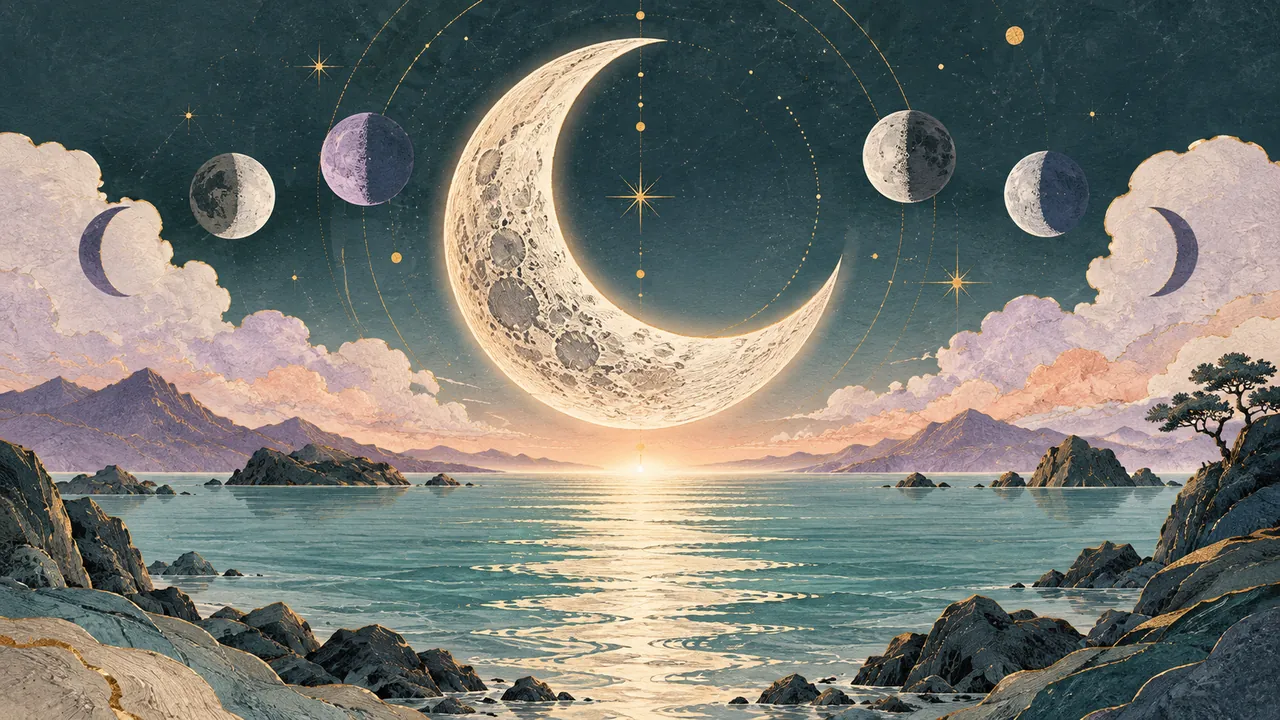
The Moon goes through eight named phases in a cycle of about 29.5 days, from new Moon to full Moon and back. You can use that rhythm as a gentle structure for reflection: a short question for each phase, written in a notebook, with no rule that you must feel a certain way. The phases are astronomy; the prompts are an optional practice.
What causes the phases
The Moon does not make its own light. Half of it is always lit by the Sun, and what changes over the month is how much of that lit half we can see from Earth as the Moon orbits us. NASA describes eight phases and a cycle of about 29.5 days (NASA Science).
A common misunderstanding is that Earth's shadow causes the phases. It does not. Earth's shadow falls on the Moon only during a lunar eclipse, which is a separate and much rarer event.
The eight phases, with optional reflection prompts
The prompts below are original Astroday suggestions. They are not ancient rituals, and they do not claim the Moon changes your mood, sleep, fertility or health. Use the ones that help; skip the rest.
| Phase | What you see | Optional prompt |
|---|---|---|
| New Moon | The Moon is near the Sun in the sky and hard to see | What would I like to pay attention to this month? |
| Waxing crescent | A thin lit sliver that grows each evening | What is one small step I could take this week? |
| First quarter | Half of the disc lit | What is getting in the way, and what is one adjustment? |
| Waxing gibbous | More than half lit, still growing | What am I refining or practising? |
| Full Moon | The whole visible disc lit | What has become clearer since the new Moon? |
| Waning gibbous | Lit portion beginning to shrink | What have I learned that I could share or write down? |
| Third (last) quarter | Half lit again, the other side | What could I let go of or simplify? |
| Waning crescent | A thin sliver before dawn | What do I need to rest from before starting again? |
Notice that the questions follow a loose arc of attention, action, clarity and rest. That arc is a writing structure, not a claim about lunar influence.
Hemisphere and time zone details
The shape looks different depending on where you are. In the Northern Hemisphere, a waxing Moon is lit on the right; in the Southern Hemisphere, it is lit on the left. Near the equator the crescent can look more like a boat. The phase is the same everywhere at the same moment, but its orientation in your sky differs.
Calendar dates can shift by a day. The exact moment of a full or new Moon is a single instant worldwide. Converted into local time, it can fall on different calendar dates in different time zones. If a calendar says the full Moon is "on the 14th", check which time zone it uses.
You can start any day
You do not need to wait for a new Moon. Find out today's phase, read its prompt and write for a few minutes. If you miss days, or a whole week, simply pick up at the current phase. A practice that tolerates gaps is more likely to last than one that demands perfection.
Observation versus interpretation
A useful habit is to keep two kinds of notes separate:
- Observation: what you actually saw or did. "Clear sky at 21:40, Moon low in the east, about three-quarters lit. Went for a walk."
- Interpretation: what you make of it. "I felt calmer after the walk. Maybe I want more evenings outside."
Keeping them apart stops you from deciding in advance that the Moon caused a feeling. Over a few months you may notice real patterns, such as "I write more on weekends", that have nothing to do with the phase, and that is valuable information too.
A simple journal layout
- Date and local time
- Phase (from a reliable source)
- What I observed (sky, weather, my day)
- Prompt answer (two or three sentences)
- One small next step, if any
A worked example (illustrative)
Hypothetical entry, first quarter:
- Observed: Half Moon visible in the afternoon sky on the way home. Busy day at work.
- Prompt: "What is getting in the way?" Too many open tasks; I keep switching between them.
- Adjustment: Tomorrow I will finish one task before opening email.
A week later, at the full Moon, the same person might write: "Finishing one task first worked on three of five days." That is a real, checkable outcome, the kind of clarity a reflective practice can offer.
Common mistakes
- Expecting a mood. No phase obliges you to feel energised or tired.
- Making it a test. Missing a phase is not failure.
- Connecting it to health decisions. Lunar prompts are for reflection, not for timing treatments or medical choices.
- Over-complicating it. Two sentences are enough.
Frequently asked questions
How long is each phase? The four main phases (new, first quarter, full, third quarter) are instants; the in-between phases each last several days within the roughly 29.5-day cycle.
Is the Moon's sign different from its phase? Yes. In astrology the Moon also moves through the zodiac signs every couple of days. Phase describes lighting; sign is an astrological placement.
Do I need to see the Moon? No. Cloudy nights are fine; the phase still applies.
For a broader routine you can pair with the lunar cycle, see Spirituality Without Religion: Where to Begin and 30 Journal Prompts for Self-Discovery.
Sources
- NASA Science, Moon Phases (astronomical facts only; not evidence for any reflective practice)
- Astroday, AI and methodology
Astroday content is for reflection and education. It is not psychotherapy, medical, legal or financial advice.