
Palm Reading Lines: A Beginner’s Guide to Their Meanings
Where to find the heart, head, life and fate lines, what palmistry traditionally associates with them, and what they cannot tell you.
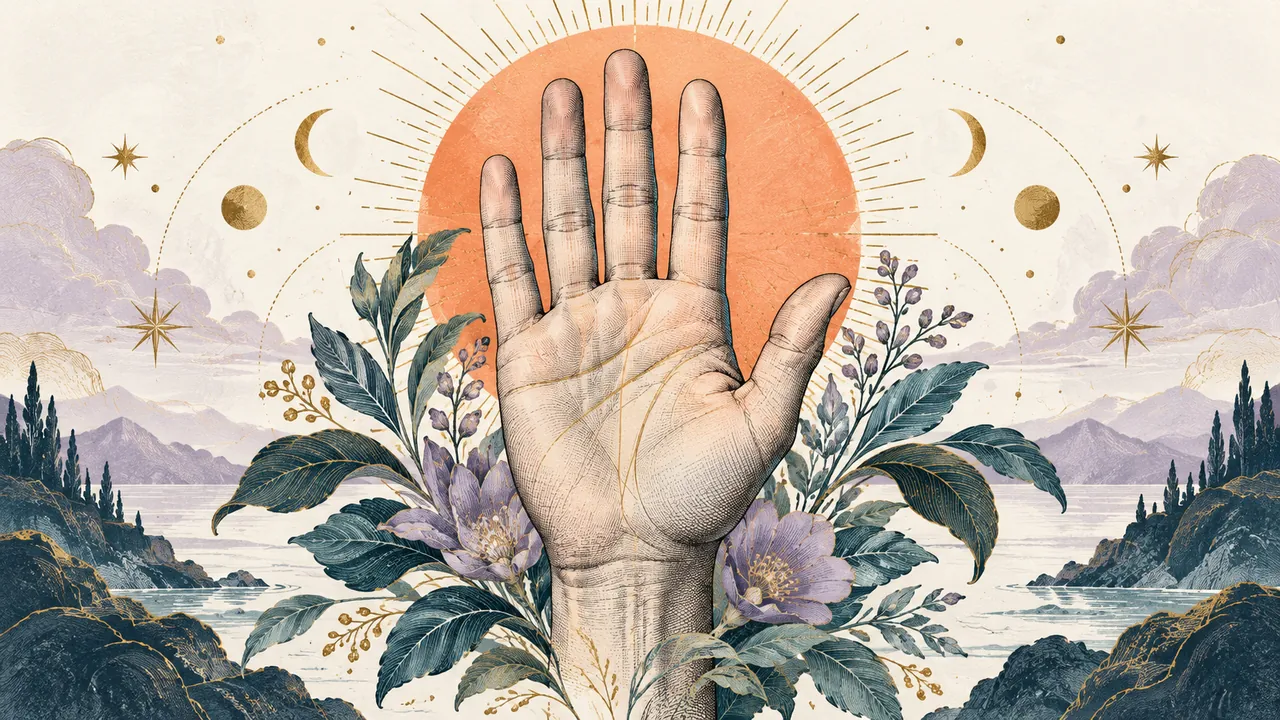
In traditional palmistry, the four main lines of the palm are the heart line, the head line, the life line and the fate line, each linked with a symbolic theme: feelings, thinking, vitality and life direction. These meanings come from folklore and divination traditions. Palm lines are not a reliable test of health, lifespan or personality, so the best way to use them is as prompts for reflection.
What palmistry is
Palmistry, also called chiromancy, is the reading of character and the future through the lines and shapes of the hand. Its origins are uncertain and it has been practised in many regions over a long history (Britannica). The creases themselves are ordinary features of skin that form as hands develop and move; their traditional meanings are cultural, not biological findings.
Finding the four main lines
Hold your hand palm up in good, even light, fingers relaxed.
Heart line
The heart line runs across the upper part of the palm, below the fingers. It usually starts near the edge of the palm under the little finger and travels towards the index or middle finger. Palmistry associates it with emotions and relationships.
Head line
The head line runs across the middle of the palm, below the heart line. It often begins between the thumb and index finger, sometimes touching the start of the life line, and travels towards the opposite edge. Palmistry associates it with thinking style and how you take in information.
Life line
The life line curves around the base of the thumb, starting between the thumb and index finger and sweeping down towards the wrist. Palmistry associates it with vitality and major life experiences.
It does not measure how long you will live. A short life line does not mean a short life. This is one of the most persistent myths about palmistry, and it has no basis.
Fate line
The fate line, when present, runs vertically up the centre of the palm towards the middle finger. Many people have a faint fate line, a broken one or none at all. Palmistry associates it with life direction or circumstances, but even within the tradition it is not read as a fixed career destiny.
Variation is normal
Hands differ enormously. Lines can be deep or faint, long or short, straight or curved, joined or separate, broken or forked. A faint, absent or unusual line is not a defect and does not predict anything bad. Some people have a single crease across the palm where the heart and head lines usually sit; this is a natural variation.
If you notice a physical change in your hands, such as swelling, pain or a new mark, speak to a medical professional. Palmistry is not a health assessment.
Which hand to read
Traditions disagree. A common approach treats the non-dominant hand as natural tendencies and the dominant hand as how those tendencies have developed through choices. Others read only the dominant hand, or both together. There is no single correct rule; choose an approach and note it down.
Respectful observation prompts
These are original Astroday suggestions. Use them for your own hands or, with permission, for a friend's.
| Observe | Ask yourself |
|---|---|
| Where the heart line ends | When do I feel most open with people I trust? |
| Whether the head line is straight or curved | Do I prefer to plan step by step or follow ideas as they come? |
| How wide the life line's curve is | What helps me feel steady and energised at the moment? |
| Whether there is a fate line | What gives my days a sense of direction, if anything? |
| Your own hand as a whole | What has my hand done today that I am grateful for? |
Notice the questions do not tell you anything. They invite you to look at your life, not to accept a verdict.
A worked example (illustrative)
Invented case: Maria has a long, curved head line and a faint, broken fate line.
- Traditional association: A curved head line is sometimes linked with imaginative thinking; a broken fate line with changes of direction.
- Reflection: "I have changed jobs twice. I do tend to follow interests rather than a plan."
- What not to conclude: That Maria cannot hold a job, will always be unsettled or is unsuited to some careers.
The value is in the reflection she wrote, not the line itself.
Taking a clear photo of your palm
If you want to look at your palm more closely or keep a record, general photography tips help:
- Use soft, even daylight; avoid harsh overhead light that creates deep shadows.
- Hold the camera parallel to the palm, fingers relaxed and slightly apart.
- Keep the whole hand in frame, including the wrist crease.
- Think about privacy before sharing hand images online.
These are general tips, not instructions for any particular app feature.
Common mistakes
- Reading lines as health or lifespan predictions.
- Treating absent lines as problems.
- Reading someone's hand without asking.
- Making decisions based on a line.
Frequently asked questions
Do palm lines change? Hands change with age, weight, work and use, so creases can change in appearance over time.
Are there more lines? Yes. Palmistry describes many minor lines and the mounts of the palm, but the four main lines are the usual starting point.
Is palmistry scientific? No. Britannica describes it as a form of divination, and there is no scientific support for its predictive meanings (Britannica). It is a cultural tradition, best used for reflection.
For reflection practices that need no tools, see Spirituality Without Religion and 30 Journal Prompts for Self-Discovery. You can also learn about palm reading on Astroday.
Sources
- Britannica, Palmistry
- Astroday, AI and methodology
Astroday content is for reflection and education. It is not psychotherapy, medical, legal or financial advice.