Sun, Moon and Rising Signs: What’s the Difference?
How astrology distinguishes your Sun, Moon and Rising signs, why birth time matters, and reflection questions for each.
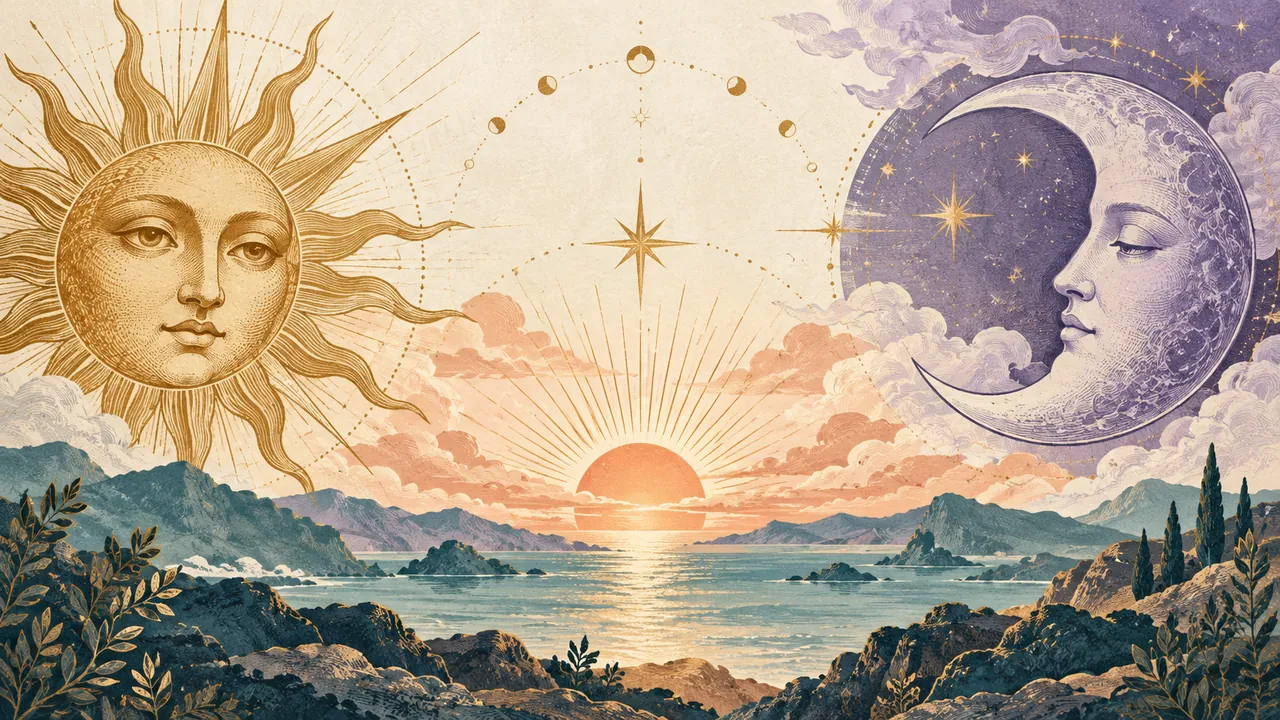
Your Sun, Moon and Rising signs are three different points in a birth chart. In astrology, the Sun sign is linked with identity and direction, the Moon sign with emotional habits and what feels comforting, and the Rising sign (Ascendant) with how you meet new situations. The Sun and Moon are positions of real bodies; the Ascendant is the zodiac sign rising on the eastern horizon at your birth time and place.
This guide uses Western tropical astrology.
These are interpretations from the astrological tradition. They are not scientifically demonstrated descriptions of personality, so the most useful way to treat them is as prompts for noticing yourself, not labels to live up to.
The three placements side by side
| Sun sign | Moon sign | Rising sign (Ascendant) | |
|---|---|---|---|
| What it is | The sign the Sun was in on your birth date | The sign the Moon was in at your birth time | The sign on the eastern horizon at your birth time and place |
| What astrology associates it with | Identity, purpose, where you put conscious effort | Emotional habits, comfort, what you need to feel settled | First approach to people and situations, style of beginning |
| Data needed | Date (time only near a sign change) | Date and, ideally, time | Exact time and place |
| How often it changes | About once a month | About every two to two and a half days | Throughout the day |
Why birth time matters so much
The Sun moves roughly one degree a day, so for most people the date alone gives the Sun sign. If you were born on a day when the Sun changed signs, you need the time to be sure.
The Moon moves much faster, changing signs every couple of days. If the Moon switched signs on your birthday, an unknown time leaves two possible Moon signs.
The Ascendant depends on Earth's rotation, so in ordinary, non-polar locations it moves through all twelve signs over about a day. You will often read that it changes "every two hours", but that is only an average. Depending on your latitude and the time of year, some signs rise in well under an hour and others take considerably longer. That is why a birth time that is off by even twenty minutes can change your Rising sign, especially far from the equator. For more on this, see Can You Read a Birth Chart Without a Birth Time?
A worked contrast (hypothetical people)
The two people below are invented. They share a Sun sign but differ in Moon and Rising, which shows why one sign never tells the whole story.
Person A: Sun in Leo, Moon in Capricorn, Rising in Virgo. Person B: Sun in Leo, Moon in Pisces, Rising in Aries.
An astrologer might read Person A's Leo Sun as wanting to create and be recognised, the Capricorn Moon as feeling safest with structure and responsibility, and the Virgo Ascendant as approaching new rooms carefully, noticing details first. The overall picture: creative ambition delivered through careful planning.
Person B's Leo Sun is read the same way, but the Pisces Moon suggests comfort in imagination and empathy, and the Aries Ascendant suggests jumping in quickly. The picture: creative ambition delivered through bold starts and emotional sensitivity.
Counterexamples that keep this honest
Now imagine Person A is spontaneous and messy, and Person B is shy. That is a reason to reject or revise the interpretation, not to dismiss the person's experience, and they are not "bad examples" of their signs. People are shaped by upbringing, culture, health, choices and circumstances. A chart offers vocabulary; it cannot override lived evidence. If a description does not fit, the description loses, not the person.
Common stereotypes to drop
- "Your Sun sign is your whole personality." It is one factor among many, even within astrology.
- "Rising is a mask, the Moon is the real you." This is a popular simplification. Many astrologers see all three as equally real.
- "Some sign combinations are incompatible or doomed." No placement makes a person unlovable or a relationship impossible.
- "Fire signs are angry, water signs are fragile." Elements describe symbolic qualities, not behaviour you are obliged to show.
One reflection question for each
Instead of asking "Is this accurate?", try asking what the symbol invites you to notice.
- Sun: "Where do I feel most like myself when I am making an effort?"
- Moon: "What do I reach for when I need to feel settled, and does it still help?"
- Rising: "How do I usually behave in the first ten minutes of something new?"
Write one honest sentence for each. Your answers are more informative about you than any sign description.
How to find your three placements
- Gather your date, time and place of birth, ideally from a birth record.
- Enter them into a chart calculator that uses the correct historical time zone for that place and date.
- Look for the Sun, the Moon (☽) and the Ascendant, often marked "ASC" on the left side of the chart wheel.
- Write down the sign of each and which calculation system you used (tropical is standard in Western astrology).
For a step-by-step approach to the rest of the chart, read How to Read a Birth Chart: A Beginner's Guide.
Can all three be the same sign?
Yes. If you were born around sunrise on a day when the Moon was in the same sign as the Sun, all three can match, sometimes called a "triple" placement. Astrology would read that theme as emphasised, but the same principle applies: notice what resonates, ignore what does not.
Frequently asked questions
Which matters most? Astrologers disagree. Many beginners start with the Sun because it is easiest to find, then add the Moon and Ascendant.
Why does my daily horoscope use my Sun sign? Sun-sign horoscopes are written for broad groups and need only a birth date. Some readers also check the text for their Rising sign.
My Rising sign changed when I corrected my birth time. Which is right? The one calculated from the most reliable recorded time.
Sources
- How birth time and location affect the Moon and rising sign, from a practitioner's perspective: CHANI, How can I work with my astrology chart if I don't know my birth time?
- Astroday, AI and methodology
Astroday content is for reflection and education. It is not psychotherapy, medical, legal or financial advice.