A Three-Card Tarot Spread for Clarity, Not Prediction
An original three-card spread: Situation, What I May Be Missing, A Useful Next Step, with a worked example and alternative reading.
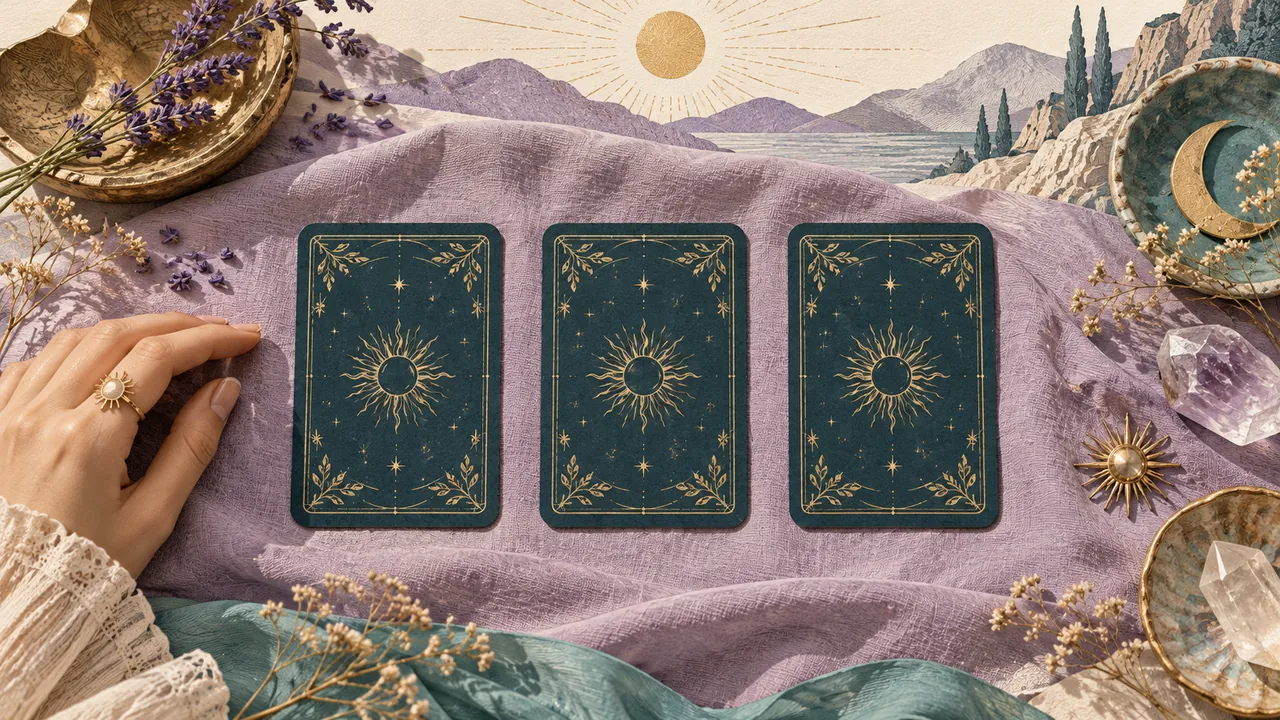
A good three-card tarot spread for clarity uses positions that point back to you rather than forward to a fixed future. This one, an original Astroday suggestion, uses Situation, What I May Be Missing and A Useful Next Step. You shuffle, draw three cards, write what you see in each image before you interpret it, and finish with one small practical action.
This is a reflective exercise you can do with any deck. It is separate from the guided tarot session on Astroday, which uses its own positions and flow.
Why "clarity, not prediction"
Many popular three-card spreads use Past / Present / Future. That can be interesting, but a "Future" card invites you to treat an image as a forecast, and forecasts tend to make people passive. Replacing it with "A Useful Next Step" keeps the reading pointed at something you can do.
The three positions
| Position | What it asks | Typical prompt |
|---|---|---|
| 1. Situation | Where am I right now? | What does this card show about how things stand? |
| 2. What I May Be Missing | What is outside my attention? | What does this card highlight that I have overlooked? |
| 3. A Useful Next Step | What could I do? | What small, concrete action does this card suggest? |
How to do the spread
- Write your question. Keep it open and about yourself, for example "What would help me feel less stuck at work?" For ideas, see 25 Tarot Questions for Self-Reflection.
- Shuffle in any way that feels comfortable: overhand, riffle, or spreading the cards face down and mixing them on the table. There is no correct method.
- Draw three cards and lay them left to right in positions 1, 2 and 3.
- Observe before interpreting. For each card, write two or three things you literally see: figures, colours, objects, direction of movement. Do not open a guidebook yet.
- Interpret. Now add the traditional meaning, if you like, and connect it to the position and your question.
- Choose one action. From card 3, write one thing you can do within the next week.
Why observing first matters
Writing what you see before you read a meaning slows you down and makes room for your own associations. It also helps you notice when you are rushing towards the interpretation you hoped for.
A worked example (hypothetical)
Question: "What would help me feel less stuck at work?"
1. Situation: Eight of Swords
- Observed: A blindfolded figure surrounded by swords stuck in the ground; the bindings look loose; there is open space behind.
- Interpretation: Feeling trapped, but the restrictions may be less fixed than they seem.
2. What I May Be Missing: Page of Cups
- Observed: A young figure holding a cup with a fish peeking out; a curious expression.
- Interpretation: Curiosity and openness. Perhaps I have stopped approaching my work with interest.
3. A Useful Next Step: Three of Pentacles
- Observed: A craftsperson working in a cathedral while two others look at plans.
- Interpretation: Collaboration and skill-sharing.
- Action: Ask a colleague in another team for a 20-minute conversation about how they approach a similar project.
An alternative reading of the same cards
Someone else might read the Eight of Swords as self-criticism rather than work conditions, the Page of Cups as an emotional message they have been ignoring, and the Three of Pentacles as a reminder that they do not have to fix everything alone. Both readings are valid. The cards offer images; meaning comes from the reader's situation. This is reflection, not prophecy.
Handling "scary" cards
Cards such as Death, The Tower or Ten of Swords can be alarming at first glance. In most tarot traditions:
- Death symbolises endings and transitions, not physical death.
- The Tower is often read as sudden change or the collapse of a false assumption.
- Ten of Swords is often read as reaching the end of a painful phase.
If a card frightens you, go back to step 4 and write what you actually see. Then ask what change or ending in your current situation the image might be pointing to, if any.
Do not redraw until you get the answer you want
It is tempting to reshuffle when a reading feels uncomfortable. Doing so turns the spread into a search for reassurance and makes every result meaningless. If a reading does not resonate, write "Doesn't fit right now" and come back another day with a different question.
Closing the reading
End by writing three lines:
- What I noticed:
- What I will try:
- When I will check in:
That last line matters. Coming back in a week to see whether the action helped is what turns a reading into useful self-reflection.
Frequently asked questions
Do reversed cards change the meaning? Some readers use reversals to soften or redirect a card's meaning; others ignore them. Either is fine, just be consistent.
Can I use this spread for other people? Keep the focus on your own choices. Reading about someone else's thoughts or intentions is not something tarot can do.
How long should it take? Fifteen to twenty minutes is plenty.
For more prompts after a reading, see 30 Journal Prompts for Self-Discovery. You can also explore tarot on Astroday.
Sources
- Background on tarot's origins as a 15th-century Italian card game: The Met, Perspectives: tarot history
- Astroday, AI and methodology
Astroday content is for reflection and education. It is not psychotherapy, medical, legal or financial advice.